

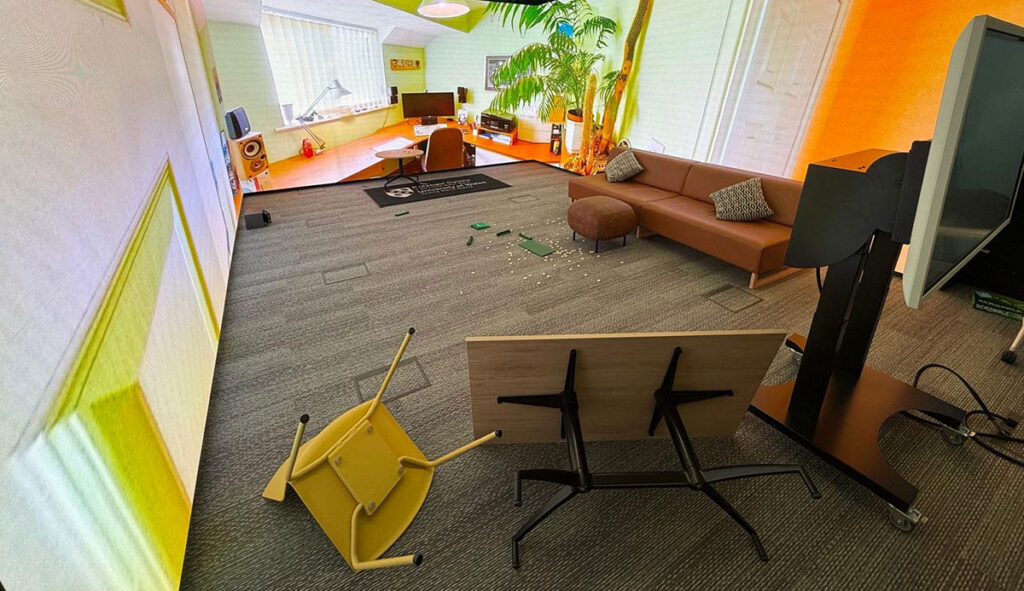
Take part in immersive law and criminology simulations, where students investigate simulated crime scenes, engage with the public through role-play, and participate in court proceedings and spatial storytelling within purpose-built immersive experiences.
What is it?
The Law and Criminology Immersive Experiences are scenario-based learning activities that place students inside a series of legal and criminal justice environments. Delivered within our Immersive Room, the space is transformed into multiple settings, including a simulated crime scene, a police reception or waiting area, and a courtroom environment, using digital backgrounds combined with physical props and furniture.
The experiences are designed as educational tools to support the teaching of investigative practice, public engagement, and legal procedures. The simulated scenarios are designed to help develop critical thinking, observational skills, professional communication, role-play confidence, and an understanding of real-world criminal justice and application of processes through active, experiential learning.
Experience and Impact
For our simulated crime scenes, we represent various forms of residential break-ins. The digital environment is enhanced with physical props and staging, allowing students to observe the space, identify potential evidence, and discuss investigative processes.
These scenarios encourage close observation, critical thinking, and provoke discussion, assisting students’ understanding of how spatial context and environmental details contribute to investigative decision-making.
We also simulate public-facing experiences through a police reception. Here, students engage in structured role-play scenarios that simulate interactions with members of the public. This phase focuses on professional communication, empathy, and decision-making, enabling students to practise managing public engagement in a controlled but realistic setting. This immersive experience supports confidence-building and essential soft skills relevant to policing and criminal justice professions.
The immersive room is also reconfigured to replicate a UK courtroom environment using a digital background and physical seating arrangements. Students participate in simulated court proceedings, adopting professional roles and engaging in legal processes through guided role-play. Often presenting opposing arguments, this scenario supports an understanding of courtroom procedure, formal communication, and professional conduct, allowing students to experience how evidence and testimony are presented and examined within a legal setting.
Across all three scenarios, the immersive experience promotes active participation and reflective learning, and all the experiences have been featured within the assessment periods of their respective courses, putting students in immersive experiences that help with relevant knowledge application.
Key Takeaways
- Highly engaging experiential immersive simulations.
- Digital backdrops and props allow for quicker turn-around for technical development.
- Scenario-based experiential learning allows for better application of knowledge and process-led subject areas.
Next Steps
- Scenarios: Expanding upon the scenarios, to assist with exposing students to different experiences for a more varied application of knowledge.
- Detail: adding more detail and nuance to the experiences, to create unique experiences.
For more information, please contact: immersive@uwtsd.ac.uk.