Special Collections and Archives
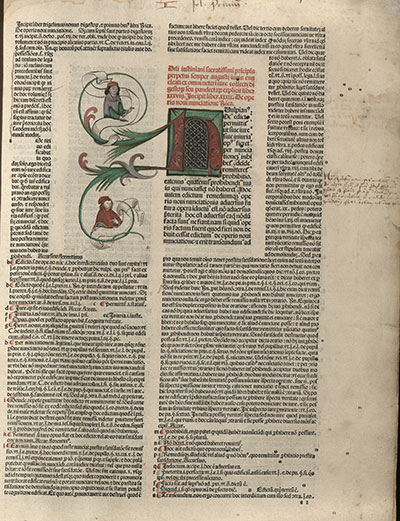
We hold a variety of editions of Greek and Latin literature, published between the 15th and 19th centuries. One of our oldest printed volumes is an edition of Plutarch’s Lives, translated into Latin by Bishop Giannantonio Campano and printed in Rome by Ulrich Han in 1470. Our copy has particularly fine hand-illuminated borders. We also hold a copy of Appianus of Alexandria’s Historia Romana, printed in Venice by Bernhard Pictor, Peter Löslein and Erhard Ratdolt in 1477. Ratdolt, an innovator added decorative initials and borders in woodcut, (rather than by hand in individual copies).
Thomas Burgess had a particular admiration for Aristotle, and so he features heavily in the bishop’s collection. Burgess possessed a Latin edition of the Rhetorica, published in Venice by Philippo de Petri in 1481. In it, Hermannus Alemannus’ translation is accompanied by commentaries of Alfaribus and Averroes. Burgess also owned a copy of Aristotle’s Poetica, published in Venice by the Aldine Press in 1536. The Greek original follows the Latin translation. The copy was bequeathed to Burgess by his friend and mentor, the scholar Thomas Tyrwhitt. We hold two volumes of the Aldine edition of Cicero’s Orationes (1541); both have been signed ‘Arundel’ by Henry Fitzalan, the twelfth Earl of Arundel.
There are a number of interesting editions of English literature. We hold two copies of The woorkes of Geffrey Chaucer (1561), edited by the antiquarian John Stow. One of these was printed by Jhon Kyngston for Jhon Wight, the other by Henry Bradsha. As Bishop Burgess had a strong interest in John Milton, we hold several editions of and commentaries on the poet. These include The doctrine & discipline of divorce (1643); Poems of Mr John Milton, both English and Latin, compos’d at several times (1645); A treatise of civil power in ecclesiastical causes (1659) and Paradise regain’d (1671). We also possess a copy of the 1827 edition of Paradise lost, featuring mezzotints by John Martin. These are considered some of the finest Milton illustrations, with strong contrasts of light and dark and futuristic scenes derived from contemporary industrial landscapes.
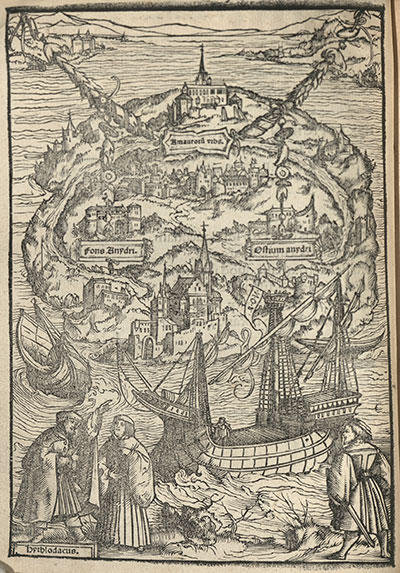
We hold two copies of Thomas More’s Utopia published by Johannes Froben in 1518. The edition contains a map of the island of Utopia, drawn by Ambrosius Holbein. We also stock the first edition of Jonathan Swift’s Gulliver’s travels (1726), originally entitled Travels into several remote nations of the world. This first edition consisted of two octavo volumes, sold for 8 shillings 6 pence. Such was its popularity that it sold out within a week; Motte followed it with two more editions in 1726.
UWTSD also possesses a copy of Edward Young’s The complaint and the consolation: or, Night thoughts, published by Richard Edwards in 1797 and illustrated by William Blake.
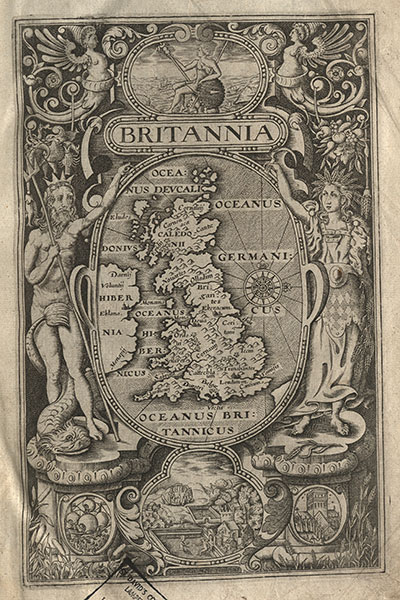
We hold a variety of classic early works of British history and British topography. These include William Camden’s Britannia: sive, Florentissimorum regnorum, Angliæ, Scotiæ, Hiberniæ, et insularum (1590), his attempt to ‘restore Britain to antiquity, and antiquity to Britain.’ We stock Camden’s biography of Elizabeth I, Annales rerum anglicarum et hibernicarum regnante Elizabetha (1615-27). There are also English translations of Britannia published in 1610 and of Annales published in 1635. There are two copies of Raphael Holinshed’s Chronicles of England, Scotland, and Ireland (1587), (although sadly both incomplete). We hold William Dugdale’s A short view of the late troubles in England, (1681), tracing the courses of the disputes that grew into the Civil Wars. However, the work is partisan; Dugdale intended it to be a personal memorial to the vileness of Charles I’s enemies.
There are several county histories, including Richard Kilburne’s A topographie or survey of the county of Kent (1659); William Burton’s The description of Leicestershire: containing matters of antiquity, history, armoury, and genealogy (second edition, enlarged and corrected, 1777) and Richard Worsley’s History of the Isle of Wight (1781). For the north of Britain, we possess Alexander Gordon’s Itinerarium Septentrionale: or, a journey thro’ most of the counties of Scotland, and those in the north of England (1727). In his dedication to Charles Duke of Queensferry and Dover, Gordon explained that he aimed to ‘illustrate the Roman actions in Scotland, and of consequence, the atchievements of its ancient inhabitants.’ We also hold a set of John Britton and E.W. Brayley’s The beauties of England and Wales (1801-1816), mostly in original blue-wrappered subscription parts.
For elsewhere in Europe, we hold two copies of Olaus Magnus’ Historia de gentibus septentrionalibus, (1558 and 1562), also a 1565 translation into Italian and a 1658 translation into English. Battista Nani’s The history of the affairs of Europe in this present age: but more particularly of the republick of Venice (1673) provides an account of the powerful republic, written by Venice’s official historian.
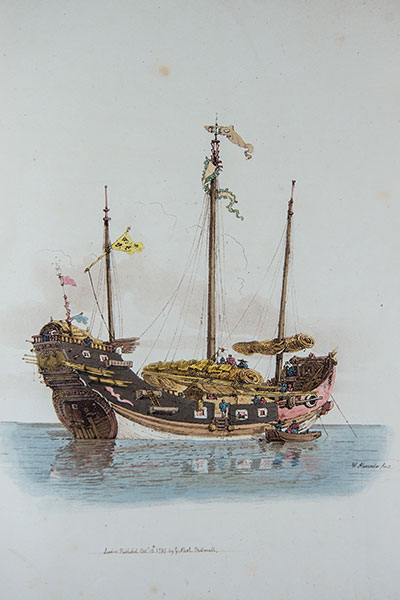
Our collections contain a magnificent selection of works on travel and exploration, mostly presented by the widely travelled Thomas Phillips. There are copies of classical works, for instance Girolamo Ruscelli’s Italian translation of Ptolemy, La Geografia di Claudio Tolomeo Alessandrino (1561), and Strabo’s Rerum Geographicarum Libri Septemdecim (1571). Despite its inaccuracies, Ptolemy’s Geography was a standard work until the 16th century. Our edition, published in Venice by Vincenzo Valgrisi, contains twenty-seven ‘traditional’ and thirty-seven ‘modern’ maps, including ten maps relating to the Americas. Strabo’s monumental work, written late in the 1st century BC or early in the 1st century AD, covered the topography of the then known world, from the Iberian Peninsula to India and from the Arctic to the Indian Ocean.
Phillips also presented copies of Abraham Ortelius’ Theatrum orbis terrarum (1606 ed.), containing Humphrey Llwyd’s first printed map of Wales, and Henry Hexham’s translation of Gerhard Mercator’s Atlas (published 1636). Later atlases in the collection include Gilles Robert de Vaugondy and Didier Robert de Vaugondy’s Atlas universel (1757) and Thomas Jefferys’ The West-India atlas (1775). Complementing these, we hold a significant collection of charts, plans and memoirs assembled and published by Alexander Dalrymple, the hydrographer to the Royal Navy. The areas charted range from Mauritius to the North Pole and from Ascension Island to Sri Lanka.
We hold many volumes associated with 18th and early 19th century explorers. They include a variety of books describing Captain James Cook’s three voyages to the Pacific Ocean, mostly written by Cook himself or by members of his crew. Slightly later, we hold a selection of volumes relating to the search for the Northwest Passage, written, amongst others, by Sir John Ross, Sir William Edward Parry, John Franklin and George Back. Other explorers represented in the collection include James Bruce, Lapérouse, George Vancouver, Mungo Park and Alexander von Humboldt.
We hold a range of volumes on natural history, covering both flora and fauna. The oldest herbal in the collection is Macer Floridus’ De viribus herbarum (1498). The volume contains sixty or so woodcuts; although the drawings are lively, they are of limited use for plant recognition. We possess the first three volumes of Hendrik Adriaan van Rheede tot Draakenstein’s magnificent Hortus Indus Malabaricus (1678). Van Rheede, the commander of the Dutch Malabar, aimed to record the details of local medicinal plants, with their traditional uses and methods of application. He relied heavily on local people, employing people of the ‘toddy-tapper’ caste to collect specimens and learned Brahmins to help write the text. Johannes Commelin’s Horti medici Amstelodamensis rariorum tam Orientalis (1697-1701) catalogues the plants found in Amsterdam’s Hortus Medicus, one of the richest collections of exotic plants in Europe. Giorgio Bonelli’s Hortus Romanus (1772-84) describes the plants grown in the Botanical Garden of Rome; we hold the first seven of the eight volumes. We also hold William Curtis’ Flora Londinensis (1777); Curtis aimed to illustrate and describe the plants growing within ten miles of London. The plates have been said to be the finest illustrations of British plants ever published. In contrast, Robert John Thornton’s New illustration of the sexual system of Linnæus (1799-1807) is of limited scientific value. However, it was the most sumptuous botanical publication that had ever been produced. The third volume, The Temple of Flora, contains thirty-one magnificent colour-engravings of flowers, painted by leading artists including Philip Reinagle and Abraham Pether.
Relating to the animal kingdom, Thomas Phillips donated three of the four volumes of Conrad Gessner’s Historia Animalium (1551-58). Gessner had attempted to record everything that ancient and modern authors had ever written about every animal species. He included some creatures whose existence was uncertain, including the sea monkey and the bishop fish. Phillips also gave a hand-coloured copy of Fischbuch, a German-language abridged version of the fourth volume on aquatic creatures. For insects, we hold Thomas Moffet’s Insectorum sive minimorum animalium theatrum (1634). Partly based on unpublished writings by Gessner and by Edward Wotton, this gives a systematic account of the habits, habitat, breeding and economic importance of insects. It has around five hundred wood engravings of varying quality. We also possess the second part of Maria Sibylla Merian’s Der rupsen begin (1714), a Dutch language translation of Der Raupen wunderbare Verwandelung und sonderbare Blumen-nahrung (popularly known as The caterpillar book). Merian, one of the earliest ecologists, included fifty plates depicting the various stages of the insect’s life from caterpillar to adult butterfly, moth or fly. In the accompanying text, she explained how her specimens looked and behaved. Our copy is hand-coloured.
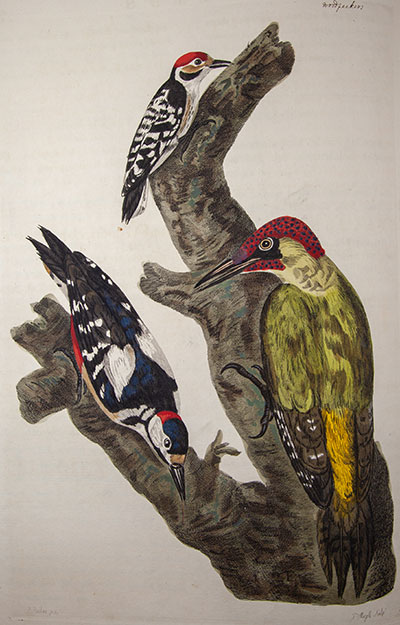
For birds, we hold Eleazar Albin’s A natural history of birds (1731-34) and George Edwards’ A natural history of uncommon birds (1743-51). We also possess copies of the beautiful first edition of Thomas Pennant’s British zoology (1766) and of the smaller, more commercially successful, second edition (1768-70).
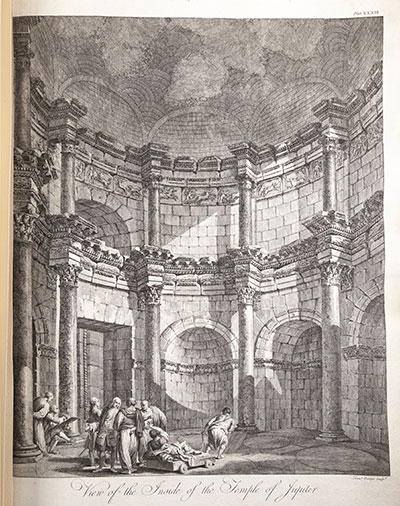
We hold a number of superb volumes of architectural plans and drawings. These include a selection of lavish volumes recording classical remains. Giambattista Piranesi’s four volume Le antichità romane (1756), an expensive Grand Tour souvenir, is a particular highlight. Other volumes are the fruit of architects’ and antiquarians’ own travels. From Robert Adam, we possess Ruins of the palace of the Emperor Diocletian at Spalatro in Dalmatia (1764) and from Robert Wood The ruins of Palmyra (1753) and The ruins of Balbec (1757).
We also hold the first three volumes of James Stuart and Nicholas Revett’s The antiquities of Athens (1762-1816). Matthew Brettingham’s The plans, elevations and sections, of Holkham in Norfolk (1773) is representative of Palladianism, E.W. Brayley’s Illustrations of Her Majesty’s Palace at Brighton (1838) of orientalism and William Chamber’s Desseins des edifices, meubles, habits, machines, et ustenciles des Chinois (1757) of chinoiserie.
We stock a wide variety of works relating to Wales’ history, topography and culture. In David Powel’s The historie of Cambria, now called Wales (1584), we hold the first printed history of Wales. Although the work was based on Humphrey Llwyd’s translation of Brut y Tywysogyon, it also contained material collected by John Prys and Edward Stradling. The text is illustrated with woodcuts of the Welsh princes, reused from the 1577 edition of Holinshead’s Chronicles of England, Scotland and Ireland.
We possess the first printed map only of Wales, drawn by Humphrey Llwyd and contained in Abraham Ortelius’ Theatrum orbis terrarum, (1606). Not everything is perfect; Milford Haven faces south-west and the Llŷn Peninsula bends towards the south. However, it is a considerable improvement on earlier maps. From a later date, we hold Lewis Morris’ Plans of the principal harbours, bays, & roads, in St George’s and the Bristol channels (new edition, 1801). Realizing that inadequate charts were contributing to frequent shipwrecks, Morris charted the Welsh coast from Great Ormes Head, north-west of Llandudno, to Tenby. His volume also contained his plans of twenty-five harbours. Our edition, revised by Morris’ son William, includes some extra harbour plans, including Aberaeron and New Quay.
For the Welsh language, we hold John Davies’ Welsh-Latin dictionary, Antiquae linguae britannicae … dictionarium duplex (1632). Davies wanted to provide materials through which English-speaking clergymen could learn Welsh, enabling them to talk to their parishioners. We also stock William Evans’ A new English-Welsh dictionary (1771); this was aimed at Welsh-speakers wanting to learn English, and at young clergymen needing to conduct services in Welsh. In his magnificent An English and Welsh dictionary (1794), John Walters hoped to enable writers to discuss all branches of knowledge and the arts in Welsh. In doing this, he coined many new words, some of them still in use today.
Tourism to Wales became popular in the last quarter of the 18th century, as fashionable travellers started to appreciate wild landscapes of cliffs, waterfalls and ruins. Between 1770 and 1815 eighty books describing tours in Wales were published. We hold a selection of these. Thomas Pennant’s A tour in Wales (1778-83) describes the six northern counties of Wales, with a heavy concentration on his native north-east. Unlike most of the English tourists, he made his observations over three tours, combined with previous experience. Also, unlike most of the other writers, he had climbed Yr Wyddfa (Snowdon) and Cader Idris. We stock Edward Pugh’s Cambria depicta (1816), the only guidebook to have been written by a Welsh speaker. Pugh spent nine years travelling all over north Wales, almost all as a pedestrian. He entertained his readers with interesting stories, gossip and his own distinctive opinions. Other guidebooks in our collection include Richard Warner’s A walk through Wales, in August 1797 (fourth edition, 1801) and A second walk through Wales (1799); George Nicholson’s The Cambrian traveller’s guide, and pocket companion (1808), and William Bingley’s North Wales delineated (1814).
We stock a selection of Welsh county histories, including Theophilus Jones’ A history of the county of Brecknock (1805-09); Samuel Rush Meyrick’s The history and antiquities of the county of Cardigan (1808), and Richard Fenton’s Historical tour through Pembrokeshire (1811).
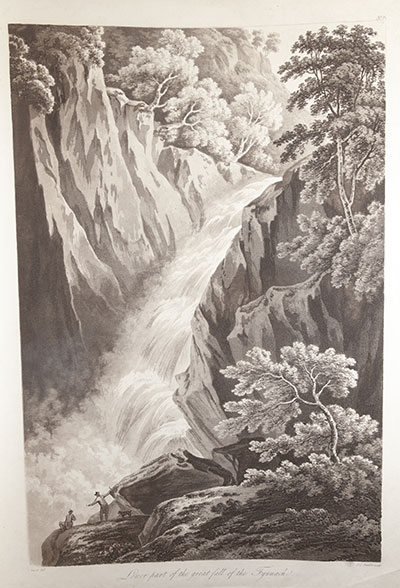
We hold two works by the Tenby local artist, Charles Norris: The architectural antiquities of Wales. Vol. 1, Pembrokeshire. No. 1[-3], St David’s (1810-11), and Etchings of Tenby (1812). In the latter book, he carefully portrayed the remains of medieval Tenby, documenting its transition from an old trading port into a Georgian holiday resort. For mid-Wales, we possess a set of John ‘Warwick’ Smith’s aquatints, Fifteen views illustrative of a tour to Hafod (1810), intended to accompany James Edward Smith’s A tour to Hafod, in Cardiganshire. The Hafod, about twenty-five miles north-east of Lampeter, was one of the finest examples of a picturesque landscape and a key site of the romantic movement.
We also stock a collection of around eight hundred 19th century Welsh ballads, purchased from Rev. D.H. Davies in 1904 as part of the Cenarth Collection. The ballads cover a variety of subjects, including criminal offences especially murders and hangings; coal mining disasters; shipwrecks; religion and revivals; love; the arrival of the railways in Wales, and local events, such as the Rebecca Riots. Some were written by famous Welsh poets, such as Tegid and Eben Fardd.