
Digital Services » Digital Learning & Library Services » Special Collections and Archives » Explore our Collections » Thomas Phillips Collection
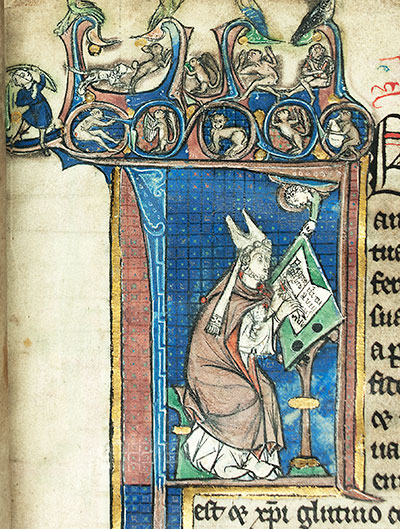
The East-India Company surgeon, Thomas Phillips (1760-1851), gave 22 500 volumes to St David’s College, Lampeter, between 1834 and 1851.
Although born in London, Phillips grew up in Radnorshire. On leaving school, he was apprenticed to an apothecary at Hay-on-Wye and then became a pupil of the leading London anatomist and surgeon, John Hunter. Unusually he ‘passed as full surgeon’ at his first attempt. In 1780, he entered the King’s Naval Service (the medical service of the Royal Navy) and sailed to Canada. On his return, he qualified as a member of the Company of Surgeons and joined the East India Company, serving initially in Calcutta. In 1796, he was sent to inspect hospitals in Botany Bay, Australia; he visited China on his journey back. He returned to Britain in 1798, where he married Althea Edwards, the daughter of the rector of Cusop in Herefordshire.
Phillips’ second tour of duty to India started in 1802. He became superintending surgeon and a member of the Bengal medical board. He saw action in Java and Nepal as well as visiting Mauritius. He also started to establish small libraries in soldiers’ mess rooms.
Phillips left India in 1817, to spend the rest of his life in London. By this time, he was a rich man, with income from his commercial undertakings in India and a full-pay pension of £1500. At some time between 1817 and 1821, he bought Camden Park, a sugar estate on the Caribbean island of St Vincent, with 164 enslaved people. In 1821, he purchased a further eighty-five enslaved people. He was eventually to receive £4737, 8 s 6d in compensation for the loss of 167 enslaved people.
Phillips’ second tour of duty to India started in 1802. He became superintending surgeon and a member of the Bengal medical board. He saw action in Java and Nepal as well as visiting Mauritius. He also started to establish small libraries in soldiers’ mess rooms.
Phillips left India in 1817, to spend the rest of his life in London. By this time, he was a rich man, with income from his commercial undertakings in India and a full-pay pension of £1500. At some time between 1817 and 1821, he bought Camden Park, a sugar estate on the Caribbean island of St Vincent, with 164 enslaved people. In 1821, he purchased a further eighty-five enslaved people. He was eventually to receive £4737, 8 s 6d in compensation for the loss of 167 enslaved people.
In marked contrast to this, Phillips dedicated his retirement to philanthropic and educational works, wanting to give away as much money as possible so he could see it well used. His main interest was in buying and distributing books in vast quantities. Phillips visited the young St David’s College in the early 1830s, met the librarian Rice Rees, and saw that the library collection was very small. Making up his time to do something about it, he donated more than 22 500 books in sixty batches between March 1834 and February 1852. The first consignment alone included early 16th century editions of Pliny and Tertullian, as well as first editions of Adam Smith’s Wealth of Nations (1776) and John Gay’s Poems on Several Occasions (1720). Following the sale of Richard Heber’s huge collection, there was a glut of old books on the market and prices were relatively low. Phillips appears to have bought through agents and auctions; it is likely the books were shipped to Carmarthen and then carried by road. Every kind of book made its way to Lampeter, ranging from medieval manuscripts to cheap school texts, and from travellers’ writings to sermons.
After Phillips’s death on 13 June 1851, more than 50 000 books waiting distribution were found in his home in Brunswick Square. He was buried, next to his wife, in the crypt of St Pancras Church, London.
Phillips’ gifts included about fifty incunables (books printed in or before 1500). Almost all of these were published in either Germany or Italy; thirty-five came from Venice, the largest publishing centre in Europe. The earliest printed work is thought to be St Jerome’s Epistolae, edited by Johannes Andreae and printed by Konrad Sweynheim and Arnold Pannartz in 1470. Boccaccio’s Genealogia deorum gentilium (1472) is a particular highlight. The book is a ‘mythological manual’ of sorts, telling the stories of about 950 Greco-Roman mythological figures and their relationships to each other. These relationships are illustrated by hand-drawn genealogical trees of the gods. The printer was Wendelin von Speyer, brother and successor to Johann von Speyer, the first printer in Venice. Another highlight is the Missale Vratislaviense, published by Peter Schöffer in Mainz in 1499. After the style of the manuscript age, Schöffer left gaps in his work to allow for hand-illuminated initials to be added. In our copy, these initials are richly executed with the use of gold leaf and decorative foliage flourishes.
Thomas Phillips was a traveller, and his collection is rich in travel books of all kinds. His earliest gifts included a copy of Abraham Ortelius’ Theatrum orbis terrarum (1606 edition), the first great European atlas. This contained the first printed map of Wales, drawn by Humphrey Llwyd of Denbigh. An engraved note above the River Teifi reads, ‘Hic fluvius solus in Britannia castores habet,’ (this is the only British river with beavers). Alongside this, Phillips also presented Henry Hexham’s English translation of Gerhard Mercator’s Atlas (published 1636).
Phillips donated a wide selection of travellers’ narratives. In the second half of the 18th century, Captain James Cook’s three expeditions to the Pacific in the 1770s had been particularly important in bringing exploration to a reading public. Numerous official and unofficial accounts of the voyages were published; more than one hundred editions and impressions were issued before 1800. Phillips’ gifts to Lampeter included John Hawkesworth’s official account of the first voyage, An account of the voyages undertaken by the order of his present Majesty for making discoveries in the Southern hemisphere (1773); the artist Sydney Parkinson’s A journal of a voyage to the South Seas (1773); Cook’s A voyage towards the South Pole and round the world (1785); William Wade Ellis’ An authentic narrative of a voyage performed by Captain Cook and Captain Clerke, in His Majesty’s ships Resolution and Discovery during the years 1776, 1777, 1778, 1779, and 1780 (1782); and Cook’s A voyage to the Pacific Ocean (1785).
Phillips spent much of his life in India working for the East India Company, and this is reflected in his donations. Many of the volumes are richly illustrated. For instance, Balthazar Solvyns’ A collection of two hundred and fifty coloured etchings descriptive of the manners, customs and dresses of the Hindoos (1799) set out to record the life of “Blacktown,” the native quarter of Calcutta. Solvyns pictured ‘the Hindu casts with their respective professions,” and the servants employed by European families, as well as methods of transport, smoking with the hooka, musical instruments, and festivals and ceremonies. William Hodges, the official artist for James Cook’s second expedition, spent six years in India. In his book Travels in India, during the years 1780, 1781, 1782, & 1783, he aimed to share his experience of India with British readers. His emphasis was on the topographic and ethnographic aspects of India, describing ‘the face of the country, of its arts, and natural productions.’ Phillips also donated a copy of Maria Graham’s Journal of a residence in India (1812), one of the first examples of British women’s travel writing on India.
Unlike India, China was almost closed to Europeans at the end of the 18th century. From 1792 to 1794, Lord George Macartney led a seven-hundred strong embassy to the Qianlong emperor, hoping to open up trade and to achieve a new era of diplomatic relations. Although the embassy was a failure, it gathered a great deal of information and sparked a renewal of British interest in China. William Alexander, the junior draughtsman, produced a vast number of sketches. His illustrations were used for the official record, George Staunton’s An authentic account of an embassy from the King of Great Britain to the Emperor of China (1797). In 1805, Alexander brought out his own book, The costume of China, containing forty-eight aquatints with commentary on each plate. Thomas Phillips also donated Æneas Anderson’s A narrative of the British embassy to China in the years 1792, 1793, and 1794 (1795) and A complete view of the Chinese empire : … and a genuine and copious account of Earl Macartney‘s embassy from the King of Great Britain to the Emperor of China (1795).
After the end of the Napoleonic wars, Britain was left in a position of dominance, and with a surplus of naval officers. Sir John Barrow, second secretary to the Treasury, seized the opportunity to search for the Northwest Passage, the sea corridor connecting the North Atlantic and Pacific oceans through the Arctic regions of North America. Between 1819 and 1836, eight expeditions set out. Then on their return, Arctic explorers’ travel narratives were turned into lavishly produced books, designed to appeal to wealthy book collectors. The Thomas Phillips collection contains a selection of these volumes, including Barrow’s A chronological history of voyages into the Arctic regions (1818); John Ross’ A voyage of discovery (1818) and Narrative of a second voyage in search of a north-west passage (1835); William Edward Parry’s Journal of a voyage for the discovery of a north-west passage from the Atlantic to the Pacific (1821) and John Franklin’s Narrative of a journey to the shores of the Polar Sea (1824).
Thomas Phillips’ gifts were rich in travel literature of another kind. On the Grand Tour, sons of the aristocracy journeyed through Europe to Italy, completing their classical education, refining their manners and learning the ways of the world. Tourists returned laden with souvenirs, for instance portraits by Pompeo Batoni and cityscapes by Canaletto and Panini. Thomas Phillips donated to St David’s College Giambattista Piranesi’s Le antichità romane, a sizeable work designed to appeal to wealthy grand tourists. The four magnificent volumes contain more than 250 images of the remains of ancient Rome; many of the plates are over two feet wide. The set would originally have sold for 30 scudi, the same price as a half-length portrait by Batoni.
Increasingly artists and architects undertook the Grand Tour too, hoping to gain knowledge and to meet wealthy patrons. Architects could then promote themselves by publishing handsome books of their drawings of ancient monuments. Phillips’ gifts included Robert Adam’s Ruins of the palace of the Emperor Diocletian at Spalatro in Dalmatia (1764); James Stuart and Nicholas Revett’s The antiquities of Athens (1762-1816), and Robert Wood’s The ruins of Palmyra (1753) and The ruins of Balbec (1757).
Phillips donated a fascinating selection of works on natural history. The oldest of these is Macer Floridus’ De viribus herbarum, probably printed at Geneva shortly before 1498. Written in Latin verse, the book describes the medicinal properties of plants. Phillips also gave three of the twelve volumes of Hendrik Adriaan van Rheede tot Draakenstein’s magnum opus Hortus Indicus Malabaricus (1678-1703). Van Rheede, the commander of Malabar, had organized a detailed survey of the plants of southwest India, particularly those with economic or medical significance. He employed local people to collect plants and learned Brahmins to help with the text, as well as using three or four artists. Other botanicals include Johannes Commelin’s Horti medici Amstelodamensis (1697-1701); Pierre Joseph Garidel’s Histoire des plantes qui naissent aux environs d’Aix et dans plusieurs autres endroits de la Provence (1715); Timothy Sheldrake’s Botanicum medicinale (1759); and seven volumes of Giorgio Bonelli’s Hortus Romanus (1772-84).
Covering a wider subject area, Phillips gave a copy of Robert Hooke’s Micrographia (1665), the first scientific best seller. In it, Hooke, the curator of experiments for the Royal Society, gathered items of original research. The subjects featured ranged from the moon to the point of a needle, and from the louse to the surface of a stinging nettle. Some of the illustrations, for instance those of the ant, the flea, and the head of a grey dronefly, are still astounding today.
For zoology, Phillips presented three of the four volumes of Conrad Gessner’s monumental Historia animalium (1551-56). Gessner had aimed to include all the information that had ever been written about every animal species. Some creatures’ existence was still uncertain; there is an illustration of a unicorn. Alongside this, Phillips also gave a copy of Fischbuch, a hand-coloured, German language “coffee table” version of the third volume on aquatic animals.
In the first two volumes of Eleazar Albin’s Natural history of birds (1731-34), Phillips donated the earliest book on birds to use coloured plates. He also gave the beautiful first edition of Thomas Pennant’s British zoology (1766), as well as the smaller, more commercially successful second edition (1768-70).