
Digital Services » Digital Learning & Library Services » Special Collections and Archives » Explore our Collections » Bishop Thomas Burgess Collection
Bishop Thomas Burgess (1756-1837), the founder of St David’s College, Lampeter, bequeathed it his personal library, comprising around 9 000 volumes.
Burgess came from Odiham, Hampshire, where his father was a grocer. He was educated at Winchester College and then Corpus Christi College, Oxford. College life suited him; he became a tutor and then a fellow of his college. He was ordained deacon and priest in 1784. He next became examining and domestic chaplain to Shute Barrington, (bishop of Salisbury from 1782 to 1791 and bishop of Durham from 1791 to 1826).
Burgess’ life was transformed in June 1803. The prime minister Henry Addington, (his contemporary at both school and university), appointed him bishop of St Davids. His new diocese was huge, covering almost half of Wales; it was also impoverished financially. Most of its clergy were poorly paid, and with low educational standards. Burgess was determined that the training for candidates to the priesthood should be improved.
Believing that most future clergy should attend a residential college within the diocese, he decided to establish a seminary at Llanddewi Brefi in Ceredigion. Draft plans and regulations were drawn up as early as 1809. But even by 1820, building had still not started, although £13 000 had been collected for the project. That spring, Burgess met John Scandrett Harford, the Lord of the Manor of Lampeter, at a dinner party held by the bishop of Gloucester. Harford offered Burgess the three-acre Castle Field site, as a potential location for the college. It was then decided to begin building as soon as possible. The foundation stone for St David’s College, Lampeter, was laid on 12 August 1822; Burgess described it as the happiest day of his life. The college opened on 1 March 1827.
Burgess had often said he would be content to remain at St Davids for the rest of his life. However, in 1825, aged sixty-eight, he became bishop of Salisbury, (thereby moving to a smaller and wealthier diocese). He died in Southampton on 19 February 1837; he is buried in the south choir transept of Salisbury cathedral.
Burgess was a fine scholar, and his collection is that of a scholarly bishop, with volumes collected over his lifetime. His first interest, as a student and then fellow at Oxford, was in classical studies. After his ordination, he widened his enthusiasms to include theology and the Hebrew language. His is very much a working library, with books purchased for use rather than for show. Many books retain a temporary publisher’s paper binding.
Burgess was an excellent classicist, who retained his interest in Greek and Latin literature throughout his life. For instance, he owned two incunables printed in Venice, Aristotle’s Rhetorica, published by Philipo de Petri in 1481, and Theodōros Gazēs’ Introductivae grammatices libri quatuor, (printed by Aldo Manuzio in 1495).
At Oxford, Burgess was mentored by the distinguished classical scholar (and editor of Chaucer), Thomas Tyrwhitt. After Tyrwhitt’s death in 1786, Burgess saw through the press his friend’s edition of Aristotle’s De Poetica, (published in 1794). Tyrwhitt also bequeathed to Burgess a 1536 Aldine edition of De Poetica. Burgess wrote on the front flyleaf, ‘Thomas Burgess Dec. 7 1797. This book belonging to my late dear friend Thomas Tyrwhitt Esq. was given me by his brother the Revd. Rob. Tyrwhitt.’ The small volume has a contemporary Italian binding; the boards are covered with an embossed red paper of floral motifs and vases. The book has also been signed by an earlier owner, W. Carte. Several people have annotated the Greek and Latin texts.
Burgess owned several more interesting copies of works by Aristotle. These included two folio volumes of the edition edited by the Swiss scholar Isaac Casaubon and published in 1605. Both books have been stamped ‘Westminster Abbey.’ Burgess also possessed ten of the eleven quarto volumes of the complete Frankfurt edition of 1577 to 1587, edited by Friedrich Sylburg. This edition is noted for its fine decorative initials and occasional illustrations.
Burgess had enough interest in the study of Homer to produce his own critical edition, Initia Homerica, (published 1788). His copy contains frequent textual corrections and proof marks made by him in manuscript. Perhaps he had hoped to publish more editions. Burgess also owned the three folio volumes of Eustathius’ commentaries on the Iliad and the Odyssey, published by Hieronymus Froben in Basel in 1560. As well as Gazēs’ Greek grammar, he owned Henri Estienne’s ten volume Thēsauros tēs ellēnikēs glōssēs, (edition published 1816 to 1828) and Johann Albert Fabricius’ twelve volume Bibliotheca Graeca (1790-1809).
Burgess was particularly interested in the Hebrew language. He was convinced that, as well as being a focus for biblical studies, learning it had both intellectual and moral implications. In his book, Motives to the study of Hebrew, (second edition, 1814), Burgess wrote, ‘You may acquire the Hebrew language, and read the Bible through in its original, in less time than you can learn to play, with tolerable dexterity, any single game at cards.’ (He is said to have found the Welsh language much more difficult than Hebrew.) He also edited several Hebrew grammars and primers.
Burgess possessed copies of John Richardson’s A grammar of the Arabic language (second edition, 1801); David Levi’s Lingua sacra (1803); Edward Moises’ The Persian interpreter (1792); and Carolus Schaaf’s Lexicon syriacum concordantiale (editio secunda, 1717).
In contrast, Burgess does not seem to have been particularly interested in the archaeology of the ancient world. He did own a copy of Description of the plain of Troy, written by the French archaeologist and traveller, Jean-Baptiste Lechevalier. (Lechevalier believed he had located the site of Troy near the modern village of Pinarbaşi.) However, Burgess acquired the book as a gift from its translator Andrew Dalzel.
Predictably, Burgess was active in the religious debates of his day, and his library is a rich resource for anyone wanting to study the numerous controversies. For instance, towards the end of Edward Gibbon’s magnum opus, The decline and fall of the Roman empire, Gibbon commented, ‘I have described the triumph of barbarism and religion; and I can only resume, in a few words, their real or imaginary connection with the ruin of ancient Rome.’ He provoked uproar in the Church of England, and a barrage of hostile pamphlets. Burgess owned a selection of volumes reacting to the controversy, written by Henry Edwards Davis, James Chelsum, East Apthorp, Francis Eyre, and Smyth Loftus. All these were issued in 1778, the year of Burgess’ graduation and two years after the publication of the first volume of Gibbon’s History.
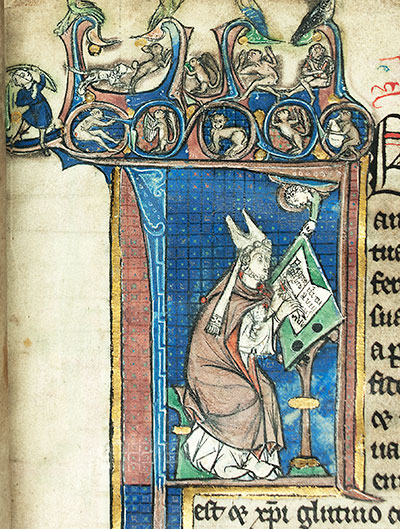
Burgess possessed two magnificent copies of the Vulgate, Jerome’s translation of the Bible into Latin. One of these was a manuscript. The unusually long colophon tells us it was the work of G. de Fécamp, a lame monk. It was completed in 1279, having taken over three years to produce. It was probably financed by James, the abbot of Saint-Pierre-sur-Dives, near Liseaux in Normandy. The initial for Song of Songs shows a Benedictine monk with a mitre, kneeling before the virgin Mary and the baby Jesus. The monk almost certainly represents Abbot James. The manuscript probably reached Britain through Carthusian channels in the 15th or 16th century.
Burgess’ second Vulgate was printed; he owned a copy of Nicholas Jenson’s 1476 Venetian Bible. The printing in rotunda face is immaculate. The first page has an ownership inscription, written in manuscript: Collegii Paris, Societ. Jesu.
Burgess possessed several outstanding Greek New Testaments. Among these were the New Testament volume of the Complutensian Polyglot Bible, sponsored by Cardinal Francisco Jiménez de Cisneros, (1514). Greek and Latin texts are printed in facing columns. It was the first printed edition of the Greek New Testament, (although not the first to be published). The Greek type is particularly impressive; the letters are large, open and elegant. Alongside this, Burgess also owned a copy of the third edition of Erasmus’ Greek New Testament, published in 1522. This was printed in Basel by Johann Froben. The Greek text is placed alongside Erasmus’ own Latin translation in facing columns. The title page is set within a woodcut border, depicting the Tablet of Cebes, an allegorical representation of the vices and virtues of human life. Burgess possessed a copy of the solely Greek New Testament, printed by Simon de Colines in Paris in 1534.
This was the first attempt to publish a critical edition; as well as using Erasmus’ text and that of the Complutensian, de Colines provided a number of unique readings, possibly with manuscript authority. Sadly, his version had no influence on later editions. The title page contains Colines’ Tempus device, depicting a figure of Father Time with his scythe. The volume also has rich-gauffered edges. Complementing this, Burgess owned a copy of a Greek New Testament issued by Claude de Marne and Andreae Wecheli Heredes in 1601. The volume was a reprint of that published in 1550 by Colines’ stepson Robert Etienne. Burgess also possessed a Syriac New Testament, edited by Guy le Fèvre de la Boderie and published in 1584. It is printed in Hebrew characters, with an interlinear Latin translation.
Burgess owned one more significant incunable. His copy of Jacobus de Voragine’s Legenda Aurea or Golden Legend, a popular book of saints’ lives, was printed by William Caxton’s successor, Wynkyn de Worde, in 1498.
Burgess owned a fine collection of works by the early church fathers: Origen, John Chrysostom, Cyril, Cyprian, and Eusebius. Among these, he possessed a copy of Photius’ Myriobiblon, (published by Jean and David Berthelin in 1653). Photius, patriarch of Constantinople in the 9th century, described several hundred books, often with thorough analyses and copious extracts. As many of the works mentioned are now lost, it is an invaluable source of information.
Relating to Britain, Burgess possessed a selection of interesting volumes. These included a 1666 edition of Richard Hooker’s Of the Laws of Ecclesiastical Polity: Eight Books, the first major work in the fields of theology, philosophy and political thought to be written in English. Burgess also owned copies of Bede’s Historia Ecclesiastica, printed by John Smith and his son George in 1722, and Henry Spelman’s Concilia (1639), an attempt to document all the church councils held in Britain or attended by British representatives, until 1066.
Burgess had a particular admiration for John Milton; his collection included Poems of Mr John Milton, both English and Latin (1645); Paradise regain’d (1671); The doctrine & discipline of divorce (1644); and A treatise of civil power in ecclesiastical causes (1659). However, Burgess also owned a copy of De doctrina Christiana, and of its translation into English, A treatise on Christian doctrine (both first published 1825). Robert Lemon, the Deputy Keeper of His Majesty’s State Papers, had found the manuscript in the State Paper Office. George IV’s librarian, Charles Sumner, then prepared it for publication.
The work was seen as heterodox, challenging the doctrine of the Trinity. Burgess was convinced it could not be by Milton, writing a series of essays and arguing his case in addresses to the Royal Society of Literature in 1826, 1827 and 1828. His book Milton not the author of the lately discovered Arian work De Doctrina Christiana (1829) gathers all his work on the subject.
Like Burgess, William Buckland, dean of Westminster and president of the Geological Society, attended Winchester College and then Corpus Christi College Oxford. Buckland gave Burgess a copy of his book Reliquiæ diluvianæ; or, observations on the organic remains contained in caves, fissures, and diluvial gravel, and on other geological phenomena, attesting the action of a universal deluge, (published 1823). In it, Buckland wrote of Kirkdale cave, about twenty-five miles north-north-east of York. Abundant animal bones had been found buried in the floor; although hyena remains were the most common, there were also elephants, rhinos, horses, oxen, deer, foxes, and rats. Buckland thought that the hyenas must have dragged the prey species into the cave, to feast on them at leisure. He concluded that the fauna must have lived on the spot, rather than the bones having been swept into Britain from the tropics in Noah’s flood. Yet Buckland still accepted the biblical flood, writing of the ‘last great convulsion that has affected our planet.’
Burgess owned a five-volume edition of the works of Isaac Newton, published between 1779 and 1785 and edited by Samuel Horsley, one of his predecessors as bishop of St Davids. He possessed a small number of popular volumes of natural history. These included Gilbert White’s A Naturalist’s Calendar (1795); Burgess’ native town of Odiham is only fourteen miles north of White’s Selborne. Burgess also owned three of the four volumes of Thomas Martyn’s Flora Rustica (1792-94) with its attractive hand-coloured etched plates.