
Digital Services » Digital Learning & Library Services » Special Collections and Archives » Explore our Collections » Bowdler Tract Collection
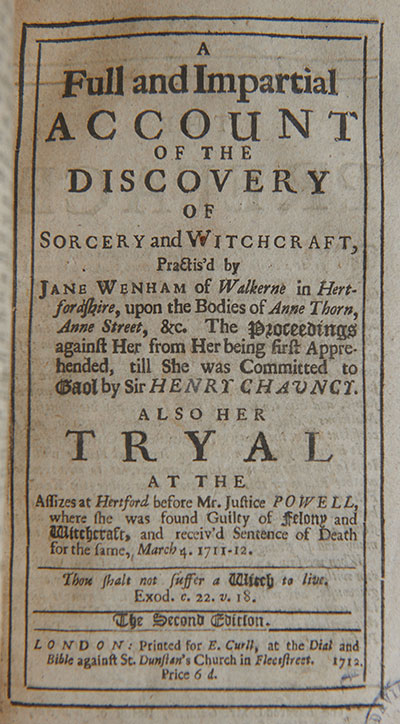
A tract has been defined as ‘a piece of religious or political propaganda, or a short treatise on a single subject.’ Cheap to print and to purchase, they were mostly written by people with axes to grind, new ideas to announce or reforms to promote.
UWTSD holds a collection of over 9000 17th and 18th century tracts, amassed by three successive generations of the Bowdler family. The earliest collector Thomas Bowdler I (active 1638 to 1700) was a city merchant. He purchased pamphlets during the English Civil Wars, the Commonwealth and early Restoration. Many of his tracts carry his signature, with the advice ‘Consider the end of all things.’
The major collector was Bowdler’s nephew, Thomas Bowdler II (1661-1738). Although Thomas Bowdler II was born in Ireland, he was brought up in the care of his uncle. When he was fifteen, he became a clerk in the Admiralty; he is said eventually to have become second in command to Samuel Pepys. Like Pepys, he resigned his post in 1689 after the Glorious Revolution and the abdication of James II. For the rest of his life, he was a convinced Jacobite and a prominent lay member of the Non-juring Communion, (those who had refused to take the oath of allegiance to the newly crowned monarchs, William and Mary).
Bowdler seems to have acquired some ready-made collections, for instance from his close friend George Hickes the former Dean of Worcester, from John Gauden the former Bishop of Worcester, and from Francis Turner, the deposed Bishop of Ely. However, it seems that between 1709 and 1718, Bowdler attempted to purchase every pamphlet that was published. He also created a meticulous catalogue of his collection, noting his dates of acquisition as well as the authorship of many anonymous works. This sort of information was rarely made public as the Non-jurors strove to avoid prosecution.
Thomas Bowdler III (c. 1708 to 1785) of Ashley, near Bath, inherited his father’s collection. His interests were less obsessive; his additions reflect more closely those of a cultivated gentleman of the time. Nothing was added to the collection after 1785.
It is likely the collection was inherited by Thomas Bowdler III’s younger son, Dr Thomas Bowdler (1754-1825). Dr Thomas Bowdler is well known for publishing the expurgated The Family Shakespeare, together with his sister Henrietta Maria. However, Dr Bowdler lived for fifteen years at the Rhyddings, near Swansea (then in the diocese of Saint David), and was part of the same pious circle as Bishop Thomas Burgess. Bowdler contributed five guineas to the St Davids college building fund in 1811. It is uncertain how the tracts reached Lampeter; it is likely they were donated as part of the Foundation collections before the opening of the college in 1827.
Despite Thomas Bowdler II’s religious sympathies, the scope of the family collection is as wide as pamphleteering itself. Although the Bowdlers were High Church Tories, they also collected the works of Catholics, Low Churchmen and dissenters. The contents of their tracts range from the high-minded to political satire, the scurrilous and the bawdy.
Predictably religious literature is dominant; the largest single category of material is the sermons. These include sermons preached on the anniversary of the execution of Charles I and of the Gunpower Plot; the addresses are likely to have a definite political theme.
The collection is particularly rich in non-juring literature, containing 539 tracts written either by or against the Non-jurors. More than half these tracts have been identified as written by known Non-jurors. Eighty-eight remain anonymous. Printers and publishers were very important to the Non-jurors. As they were forbidden to preach in the national pulpits and their congregations were small, they were forced to use the press to disseminate their views. (Our collection includes as many as fifty-five tracts written by Charles Leslie, with twenty-two each by Jeremy Collier and Thomas Brett). The main printers were John Morphew, James Bettenham, George Strahan and Henry Clements. They too risked being prosecuted and punished for distributing seditious material. Sometimes they offered work, usually typesetting and proof-reading, to non-juring clergy lacking any other means of support.
The South Sea bubble was a series of financial speculations in stocks of the South Sea Company. Government debt was converted into shares in the company; the government and the company launched an energetic marketing campaign to persuade investors to buy these shares. More than twice the amount of stock available was sold. In 1720, the value of a share rose to £1050 and then plummeted to £124. Many people lost their fortunes overnight; it had been the first international stock market crash.
UWTSD holds a selection of related pamphlets. The author of A true account of the design and advantages of the South-Sea trade (1711) wrote ‘Besides this provision for the interest at six per cent of all the national debts, the Parliament readily gave into a project … for incorporating the proprietors of the said debts to carry on a trade to the South-Seas: whereby a further advantage will, in all probability, accrue to the said proprietors, and, through their means, to the whole nation.’ But the writer of An examination and explanation of the South-Sea Company’s scheme, for taking in the publick debts warned ‘Upon this supposition, the plain fact and naked truth is, that the buyers, or those who shall become the proprietors of the engrafted stock, will be the persons whose estates are to be diminish’d of so money as is to be divided between the Government and the present directors, and other proprietors of the South Sea Company.’ William Rufus Chetwood’s The stock-jobbers: or, the humours of exchange-alley was one of several plays dealing with the financial market and its speculative practices, written or performed in 1720.
In it, Sir John Wealthy announces that he has bought ‘about 10 shares, and sold 15; four to Mr Noodle, the good-humour’d gentleman from t’other end of the town, that owns the fine gilt chariot. Three to Captain Sanguine, newly return’d from the East-Indies, he’s full of money, and bleeds like a young heir. Item, three more to a whimsical musical sort of a gentleman, just come from Italy …’ Other tracts in UWTSD’s collections include Francis, Lord Bacon: or, the case of private and national corruption, and bribery, impartially consider’d (second edition, 1721); A letter to a friend concerning the proposals for the payment of the nation’s debts (1720) and A modest apology, occasion’d by the late unhappy turn of affairs, with relation to publick credit (1721).
The 17th century was the golden age of British astrology and astrological material is well represented in the Bowdlers’ collection. Other than the Bible, the astrologer’s almanac was far and away the most popular type of literature. These almanacs were cheap annual publications containing ‘tables of the astronomical and astrological events of the coming year: the movements and conjunctions of the planets and stars in the zodiac and details of eclipse.’ Most also disseminated a range of other non-astrological material to a national audience.
The earliest almanacs in our collections date from the English Civil Wars. The Bowdlers possessed copies of John Booker’s Mercurius cœlicus from 1644 and William Lilly’s Merlinus Anglicus Junior, also from 1644. We hold a copy of Lilly’s Monarchy or no monarchy in England. Grebner his prophecy concerning Charles son of Charles, his greatnesse, victories, conquests (1651). The volume ends with a series of prophetic woodcuts; these include illustrations of corpses wrapped in shrouds and of a city in flames. Lilly was said to have foreseen the Great Plague and the Great Fire of London.
In Mr John Partridge’s new prophesie of this present year 1684, Partridge, a political radical, predicted ‘’we have reason to fear this year may prove more calamitous then [sic] most we have yet seen, there being scarce any affliction incident to men which we are not more or less threatened with.’ After having escaped to the Netherlands, Partridge predicted the death of James II in Mene tekel: being an astrological judgment on the great and wonderful year 1688. UWTSD holds a French translation.
But in 1708, Jonathan Swift played an elaborate April Fools’ Day joke, predicting Partridge’s death in a pamphlet Predictions for the year 1708. Next Swift issued another publication, The accomplishment of the first of Mr Bickerstaff’s predictions, being an account of the death of Mr Partridge the almanack-maker upon the 29th instant. Although Partridge insisted that he was still alive, Swift argued that he must be dead as ‘no man alive ever writ such damn’d stuff as this’.
Tracts on science and medicine are scattered through the Bowdlers’ collection. For instance, they possessed two scientific pamphlets by Robert Boyle, the man who, more than anyone else, invented the modern experimental method. These were Salt-water sweetned: or, a true account of the great advantages of this new invention both by sea and by land (1683) and Experiments and considerations about the porosity of bodies, in two essays (1684). The Bowdlers also owned An attempt to prove the motion of the earth (1674), written by Boyle’s protégé, Robert Hooke. In it, Hooke surmised, ‘That all cœlestial bodies whatsoever, have an attraction or gravitating power towards their own centers, whereby they attract not only their own parts, and keep them from flying from them, as we may observe the earth to do, but that they do also attract all the other cœlestial bodies that are within the sphere of their activity.’
The Bowdlers also possessed A course of mechanical and experimental philosophy, a brochure for a course of lectures given by John Theophilus Desaguliers. The text lists no fewer than 150 experiments to be undertaken. Desagulier had followed in Hooke’s footsteps as curator of experiments for the Royal Society. His popular lectures aimed to demonstrate Isaac Newton’s theories to a non-academic audience. Desaguliers established himself as one of London’s leading public experimental lecturers.
For medicine, the Bowdlers owned a copy of Richard Mead’s A short discourse concerning pestilential contagion, and the methods to be used to prevent it, (1720). Reacting to an outbreak of plague in Marseilles, Mead argued that plague was contagious. Rather than quarantining whole households, he recommended separating the sick from the well. Seven editions were published within a year; an enlarged eighth edition followed in 1822.
Daniel Defoe (1660?-1731) is the writer most frequently encountered in the Bowdlers’ collection. Although mostly remembered as a novelist, he produced over 300 works, largely topical political commentary in tracts and periodicals. These included sixty-five individual works on issues affecting the Dissenters, fifty-five or so on the recurring threat of the Jacobites, and thirty-five on the Scottish Union. Defoe signed very few of his pamphlets; his favourite soubriquet was ‘Author of the true-born Englishman.’ This was a verse satire, championing the Dutch-born king of Britain, William III. Defoe described the British as a ‘mongrel half-bred race,’ describing ‘a true-born Englishman’ as ‘a contradiction.’ The poem made Defoe famous, going through twenty-two known editions in his lifetime.
Other pamphlets by Defoe in the Bowdlers’ collection included: Armageddon: or the necessity of carrying on the war … (1711); The ballance of Europe (1711); Advice to the people of Great Britain (1714), and Every-body’s business, is no-body’s business (1725).
Defoe was also the founder of the Review, a periodical that appeared three times a week from February 1704 until June 1713. Commenting on current political, economic, and military topics, it was written almost exclusively by Defoe himself. The Bowdlers’ set of the Review included no. 81, published in April 1713 and dealing with the Treaty of Utrecht and the Treaty of Commerce. This issue has not been traced in any other library.